|
|
|
|
NEWSLETTER ·
SAMVAAD SPECIAL EDITION
|
|
|
|
In the
November
edition
of
Varta,
we
revisit
SamvAAD
2026.
This was
our
third
edition
overall,
but the
first
since
Sahamati
was
recognised
as a
Self-Regulatory
Organisation
(SRO).
The
event
brought
together
regulators,
industry
leaders
and
ecosystem
participants
to shape
the
future
of
consent-based
financial
data
sharing.
SamvAAD
2026
also
marked
an
important
milestone
in the
Account
Aggregator
(AA)
ecosystem’s
journey
towards
an
interoperable
network,
stronger
collaboration
and
sustainable
ecosystem
growth.
The
event
marked
several
important
milestones
for
Sahamati.
Shri
Nandan
Nilekani
launched
#AASeAasaanHai,
Sahamati’s
consumer
awareness
campaign
aimed at
making
the
benefits
of AA
accessible
to every
Indian.
We also
released
the
CRIF-Sahamati
report,
examining
the AA
framework’s
impact
on
credit
access.
Adding
to these
milestones,
we have
announced
Sahamati’s
Annual
Report
2026,
Stewarding
Open
Finance:
Participatory
Foundations
of the
AA
Ecosystem,
which
reflects
on two
years of
progress
and
collective
efforts
since
SamvAAD
2024.
Going
forward,
we also
explore
two
significant
developments
advancing
the AA
ecosystem:
interoperability
and the
rollout
of a
common
Economic
Model.
In
addition,
we bring
you the
latest
on
common
standards
and best
practices,
highlighting
key
regulatory
and
operational
measures
aimed at
strengthening
the
ecosystem’s
long-term
sustainability.
|
|
|
|
India’s
Account
Aggregator
(AA)
ecosystem
has made
significant
strides in
advancing
consent-based
financial
data
sharing.
As
adoption
grows,
the
priority
is to
make the
ecosystem
more
accessible,
interoperable
and
sustainable.
This
will
require
continued
collaboration
across
regulators,
financial
institutions
and
technology
partners.
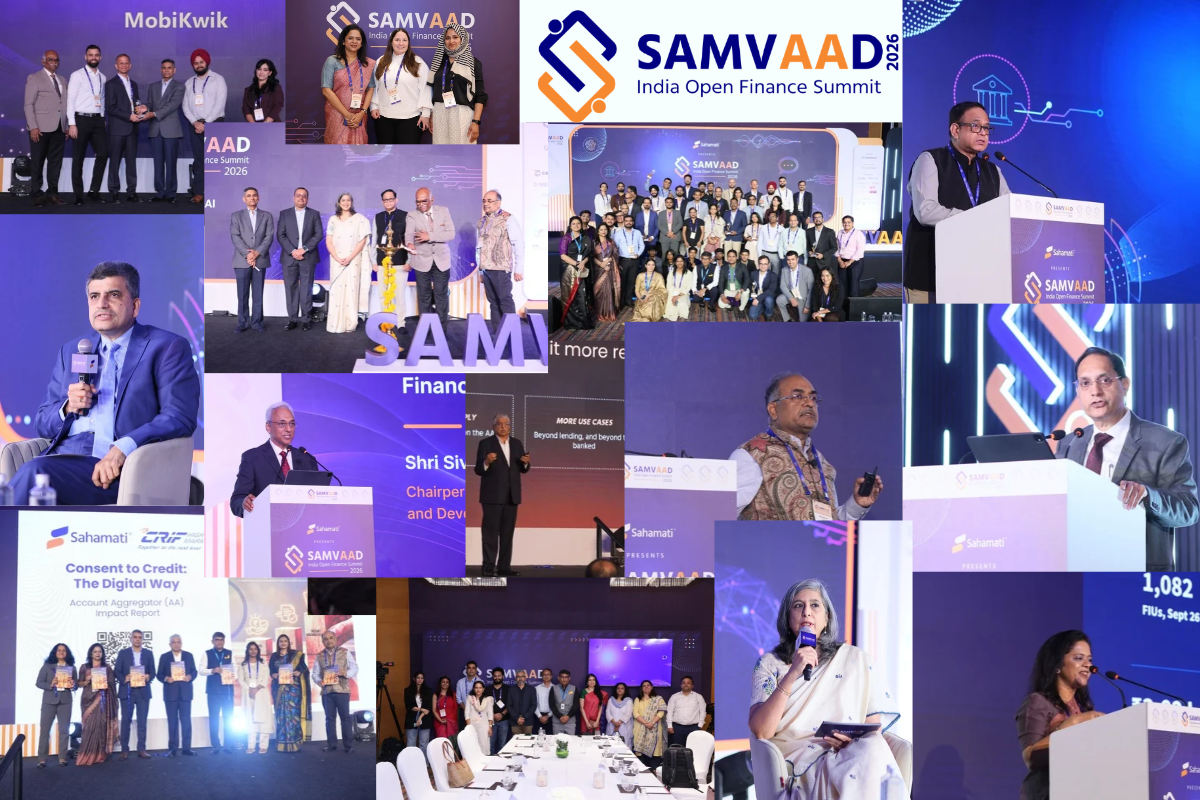
Held
on 14-15
October,
SamvAAD
2026,
India’s
largest
Account
Aggregator
community
event,
marked
its third
edition
and the
first
since
Sahamati’s
recognition
as a
Self-Regulatory
Organisation
(SRO).
The event
brought
together
over 1,000
attendees
and 100
speakers
across the
two days. In
a
significant
first for
the
ecosystem,
all four
financial
sector
regulators
came
together at
SamvAAD,
providing a
unique
platform for
collective
dialogue on
the
ecosystem’s
progress and
future
direction.
The event
also
showcased
award-winning
implementations,
highlighted
impactful
use cases,
and explored
the next
phase of
India’s
Account
Aggregator
(AA)
framework.
Interoperability
will be
central
to the
next
phase of
AA
growth.
It will move
the
framework
beyond
individual
institutional
connections
towards a
seamlessly
connected
network,
allowing
consumers to
access
financial
services
through
their
preferred
Account
Aggregator,
irrespective
of which AA
their
financial
institution
is connected
to. This
puts
consumer
choice and
agency at
the heart of
consent-based
data
sharing.
With
627.6
million
fulfilled
consents
and
372.57
million
linked
accounts
as of
October
2026, the
opportunity
is to
translate
this growth
into greater
consumer
awareness
and
participation.
Sahamati’s
consumer
awareness
initiative,
#AAseAasaanHai,
launched at
SamvAAD, is
a step in
this
direction.
Another
important
step towards
strengthening
the AA
ecosystem is
the
announcement
of a
common
Economic
Model.
The model
has evolved
through a
three-year,
multi-stakeholder
process
involving
inputs from
Financial
Information
Users
(FIUs),
Financial
Information
Providers
(FIPs) and
Account
Aggregators.
It is an
important
step towards
building a
sustainable
ecosystem
that
supports
continued
innovation
and delivers
lasting
value to all
participants.
The
next phase
of AA growth
will depend
on strong
institutional
partnerships
and our
ability
to
translate
infrastructure
into
meaningful
outcomes
for
consumers.
I
would like
to thank
everyone who
contributed
to the
event’s
success. My
special
thanks go to
our
distinguished
speakers for
their
valuable
insights and
perspectives,
and our
sponsors for
their
continued
support. I
am also
grateful to
Shri Nandan
Nilekani,
Shri Kesavan
Ramachandran,
Shri Tuhin
Kanta
Pandey, Shri
Ajay Seth,
and Shri
Sivasubramanian
Raman for
honouring us
with their
presence at
the event.
Finally, I
would like
to recognise
the
tremendous
effort put
in by the
entire
Sahamati
team in
organising
an event of
this
scale.
SamvAAD
2026 has
been an
important
milestone,
but it is
also a
reminder of
how much
more we can
achieve
together. We
have laid
strong
foundations
and built
considerable
momentum. I
look forward
to
continuing
this journey
with all our
ecosystem
partners as
we work
towards
making
consent-based
financial
data sharing
more
inclusive
and
impactful.
|
|
|
|
|
|
|
|
The Pulse:
Ecosystem
Stats
|
|
627+ M
Consents
Fulfilled
(cumulative)
32+
M
Monthly
Consents
177
FIPs
Live
on
AAs
|
|
372+ M
Accounts
Linked
20+
M
Monthly
Accounts
Linked
1076
FIUs
Live
on
AAs
|
|
406+ M
Monthly
Data
Shares
|
1330
Live
REs
on
AA
16
Total
Operational
AAs
|
|
|
|
|
|
Launch
of AA Se
Aasaan
Hai:
India’s
First
Account
Aggregator
Consumer
Awareness
Campaign↗️
At
SamvAAd 2026, Shri
Nandan Nilekani,
Co-Founder &
Chairman, Infosys,
and Founding
Chairman, UIDAI
(Aadhaar), launched
AA Se Aasaan Hai.
This
first-of-its-kind
Sahamati consumer
awareness campaign
aims to make AA easy
to understand and
accessible for every
Indian. The
campaign’s first
film, Deepak –
The Dreamer, brings
to life the
challenges of
securing a loan
without conventional
income proof and
highlights how AA
simplifies financial
information sharing
through a secure,
digital, and
consent-based
process. Through
relatable stories
and everyday
financial journeys,
the initiative aims
to build consumer
awareness and trust,
accelerating AA
adoption across
India.
Explore
more
Sahamati
Annual
Report
2026
|
Now
Available ↗️
“A
core
goal of
public
policy
should
be to
facilitate
the
development
of
institutions
that
bring
out the
best in
humans.”
—
Elinor
Ostrom
Reflecting
this philosophy,
Sahamati’s
Annual Report
2026, Stewarding
Open Finance:
Participatory
Foundations of
the AA
Ecosystem, looks
back at two
years of
progress since
SamvAAd 2024. It
captures the
collective
efforts shaping
India’s Account
Aggregator
ecosystem and
Sahamati’s
evolution into
an
RBI-recognised
Self-Regulatory
Organisation
(SRO-AA).
Consent to
Credit:
Launch of
the First AA
Impact
Report ↗️
Launched at
SamvAAd 2026,
Consent to
Credit –
The Digital Way,
a joint report
by Sahamati and
CRIF, presents
the first
comprehensive
assessment of
the
AAframework’s
impact on
lending. Drawing
on
FY25–FY26
data, the report
reveals how
AA-enabled
lending is
driving faster
credit growth,
expanding access
for
new-to-credit
borrowers,
enabling higher
loan amounts,
and supporting
healthier loan
portfolios. The
findings mark an
important
milestone in
demonstrating
AA’s measurable
impact on
India’s credit
ecosystem.
|
|
|
|
Voice-led
AA
Consent:
Making
Consent
More
Accessible
Developed
through
a
collaboration
between
Sahamati,
Accion
and
Finvu,
the
voice-led
consent
journey
enables
customers
to
navigate
the
AA
consent
process
through
conversational
voice
interactions
in
vernacular
languages.
The
solution
was
demonstrated
at
SamvAAd
2026
by
the
Accion
and
Finvu
teams,
showcasing
how
voice
interfaces
can
make
informed,
consent-based
financial
data
sharing
more
accessible,
intuitive
and
inclusive.
Account
Aggregator
Certified
Professional
(AACP):
In
collaboration
with
Accion
Sahamati,
in
collaboration
with
Accion,
launched
the
Account
Aggregator
Certified
Professional
(AACP),
an
industry
certification
programme
designed
to
build
practical
capabilities
among
financial
services
professionals.
The
programme
covers
the
operational,
technological
and
institutional
dimensions
of
the
AA
framework,
while
exploring
the
principles
of
consent-based
data
sharing,
interoperability
and
effective
ecosystem
governance.
It
aims
to
equip
practitioners
with
the
knowledge
to
understand,
implement
and
leverage
the
AA
framework,
and
contribute
to
the
broader
evolution
of
Open
Finance.
Airtel
Payments
Bank:
Beta
Launch
of
Interoperable
Bank
Statements
through
BCs
Airtel
Payments
Bank
showcased
the
beta
launch
of
an
AA-powered
interoperable
bank
statement
service,
enabling
customers
to
access
their
bank
statements
across
participating
banks
through
Business
Correspondent
(BC)
points.
With
Airtel
Payments
Bank
acting
as
the
Financial
Information
User
(FIU),
the
initiative
demonstrates
how
the
AA
framework
can
extend
beyond
digital
channels
to
assisted,
last-mile
delivery
of
financial
services,
particularly
for
customers
with
limited
access
to
digital
banking.
|
|
|
|
|
Sahamati
has made progress on
two key
initiatives:
Billing under the
Economic Model
and AA
interoperability.
Billing (Economic
Model): FIU-side
interfaces in SNA now
enable AAs to use the
same agent already
deployed for SLA and
SaaNS reporting,
removing the need to
build separate capture
logic. A settlement
engine has also been
implemented, with
contributions from
developers across AAs.
AA Interoperability:
Collaboration with ReBIT
and Regulated Entities
(REs) continues to
support the
implementation of
technical specifications
across the ecosystem.
Several webinars for
AAs, FIUs and FIPs were
followed by more than
five Q&A sessions to
address implementation
questions.
A new gateway component
helps REs adopt
interoperability faster
by providing common
functionality they would
otherwise need to build
independently. This
reduces duplicated
effort and supports
consistent
implementation across
the ecosystem.
|
|
Common
Standards and Best
Practices
|
|
SLA
Framework
Rolled
Out;
Code
of
Conduct
Updated
to
v2.2
On
14
October
2026,
Sahamati
rolled
out
the
Service
Level
Agreement
(SLA)
Framework
for
the
AA
ecosystem,
establishing
common
benchmarks
for
service
quality
and
reliability.
As
the
first
phase
of
implementation,
AAs
are
measuring
Financial
Information
Provider
(FIP)
SLAs
and
reporting
FIP
performance
data
to
Sahamati
through
the
SahamatiNet
Agent.
FIPs
will
receive
monthly
performance
reports
based
on
the
defined
SLAs.
Alongside
the
SLA
rollout,
Code
of
Conduct
v2.2
was
released,
introducing
six
new
mandatory
codes
(CC063–CC068)
that
supplement
the
SLA
requirements
and
establish
expectations
for
FIPs,
AAs
and
Financial
Information
User
(FIUs).
Read
more:
SLA
Framework
|
Code
of
Conduct
v2.2
Fair
Use
Implementation
Guidelines
v2.0
Released
Sahamati
released
Fair
Use
Implementation
Guidelines
v2.0,
consolidating
implementation
requirements
for
FIUs,
FIPs
and
AAs.
The
guidelines
introduce
a
machine-readable
Fair
Use
Registry
(XML
and
JSON),
enabling
FIUs
to
pass
the
applicable
Template
ID
through
the
Purpose
refUri
field
and
allowing
AAs
and
FIPs
to
validate
consent
attributes
against
the
Registry.
FIUs
must
start
passing
Template
IDs
by
30
November
2026.
AAs
and
FIPs
must
inspect
the
refUri
field
from
this
date.
FIPs
to
Enable
All
Applicable
FI
Types
and
Account
Types
In
line
with
the
principle
of
reciprocity
under
the
RBI
Master
Direction
for
NBFC-AAs,
FIPs
must
enable
all
applicable
FI[CD4]
Types
and
Account
Types
they
hold
and
ensure
they
adopt
the
latest
active
ReBIT
FI
Schemas.
This
includes
relevant
account
types
such
as
Sole
Proprietorship
and
Current
Accounts
for
banking
FIPs.
FIPs
must
complete
the
enablement
and
go
live
by
30
November
2026.
Those
FIPs
preparing
to
go
live
must
ensure
they
meet
the
guidelines
before
commencing
FIP
operations.
Additional
Identifiers
for
Account
Discovery
On
20
August
2026,
Sahamati
issued
a
revised
circular,
requiring
RBI-regulated
FIPs
to
support
PAN
and/or
Date
of
Birth
(DOB),
alongside
the
registered
mobile
number,
for
account
discovery.
The
revised
guidelines
align
validation
logic
with
ReBIT
standards
and
prescribe
standardised
validation
scenarios
and
error
responses.
The
implementation
deadline
for
UAT
and
Production
was
31
October
2026.
|
|
|
|
|
Business
Standard
examines
how
interoperability
across
the
AA
ecosystem
is
expected
to
reduce
customer
drop-offs
during
loan
applications
by
simplifying
data-sharing
processes.
It
will
allow
lenders
to
access
a
wider
network
of
AAs
without
establishing
multiple
bilateral
integrations,
potentially
improving
onboarding,
data-fetching
success
rates
and
operational
efficiency.
RBI
announces
two
key
measures
to
make
financial
data
easier
to
access
Outlook
Money
considers
how
the
RBI’s
interoperability
initiative
and
proposed
integration
of
bank
deposits
into
CAS
are
expected
to
improve
access
to
financial
information.
Customers
will
have
greater
flexibility
in
choosing
their
Account
Aggregator,
while
the
expanded
CAS
will
offer
a
more
comprehensive
view
of
their
financial
holdings.
Loan
seekers
sharing
bank
data:
Three
times
more
likely
to
get
business
loans
Times
of
India
reports
that
the
CRIF-Sahamati
study
finds
that
borrowers
sharing
bank
account
information
through
the
AA
framework
are
more
likely
to
secure
business
loans.
Among
borrowers
seeking
loans
of
₹10–25
lakh,
new-to-credit
customers
accounted
for
28.5%
of
AA-enabled
lending,
compared
with
8.6%
among
non-AA
lenders.
The
findings
highlight
AA’s
potential
to
expand
formal
credit
access
to
underserved
businesses.
Account
Aggregator-led
lending
touches
₹3.82
lakh
crore
in
FY26
with
no
hit
to
loan
quality
CNBC-TV18
discusses
how
the
AA-enabled
lending
reached
₹3.82
lakh
crore
across
approximately
3.68
crore
loans
in
FY26,
according
to
the
CRIF-Sahamati
report.
The
study
finds
that
lenders
using
the
framework
maintained
comparable
or
better
portfolio
quality
across
several
lending
segments,
demonstrating
the
potential
to
expand
credit
access
without
compromising
asset
quality.
Nandan
Nilekani
calls
for
expanding
Account
Aggregators
to
reach
street
vendors
for
access
to
credit
Economic
Times
reports
from
SamvAAd
2026,
saying
Nandan
Nilekani
called
for
expanding
the
AA
framework
to
reach
street
vendors,
gig
workers
and
small
businesses.
He
emphasised
the
need
to
incorporate
more
financial
information,
including
GST
records,
income-tax
returns
and
utility
payments,
to
help
lenders
assess
cash
flows
and
extend
formal
credit
to
underserved
borrowers.
SEBI
working
to
add
more
financial
information
to
Account
Aggregator
framework
Moneycontrol
discusses
how
SEBI
is
exploring
ways
to
expand
the
financial
information
available
through
the
AA
framework,
including
additional
securities
and
investment-related
data.
The
regulator
is
also
examining
improvements
to
Consolidated
Account
Statements,
with
the
aim
of
providing
investors
with
a
more
comprehensive
view
of
their
financial
assets.
IRDAI
explores
financing
options
to
help
policyholders
retain
life
insurance
policies
NDTV
Profit
reports
that
IRDAI
is
exploring
financing
options
that
could
help
policyholders
avoid
surrendering
life
insurance
policies
because
of
difficulties
in
paying
premiums.
One
proposal
involves
financing
outstanding
premiums
against
the
policy’s
surrender
value,
enabling
customers
to
retain
their
policies
and
receive
their
intended
maturity
benefits.
|
|
SamvAAd2026:
Livestreamed
|
|
Missed
SamvAAd2026?
Catch
the
CNBC-TV18
livestream
of
SamvAAD
2026.
Revisit
the
event’s
key
moments
to
gather
insights
from the
event as
they
unfolded.
‘Our
neutrality
is
our
licence’:
PFRDA
Chairman
warns
against
data
misuse
ANI says
PFRDA
Chairman
Sivasubramanian
Ramann
emphasised
that
maintaining
neutrality
is
fundamental
to the
credibility
of
consent
managers.
He
cautioned
against
the
misuse
of
customer
financial
information
for
profiling
or
commercial
purposes,
reiterating
that
Account
Aggregators
must
preserve
data
privacy
and
operate
as
neutral
intermediaries.
SamvAAd
Summit:
Nandan
Nilekani
on
Account
Aggregators,
small
businesses
and
gig
workers
CNBC-TV18
reports
from
SamvAAd,
saying
Nandan
Nilekani
highlighted
the
potential
of
Account
Aggregators
to
expand
access
to
formal
credit
for
small
businesses,
gig
workers
and
underserved
communities.
He
emphasised
the need
to
broaden
the
network’s
reach,
incorporate
more
financial
information
and
strengthen
the
ecosystem
to
support
inclusive
economic
growth.
|
|
|
|
|
Follow
AA
Se
Aasaan
Hai
and
help
us
reach
every
Indian!
|
|
|
|
|
|
|
Sahamati
Foundation
is a
member-driven
industry
alliance
formed to
promote and
strengthen
the Account
Aggregator
ecosystem in
India.
|
|
|
|
|
|
|
|
|
|
|
|
|